Start with the kilowatt-hours on your electricity bills, then separate daytime demand, night-time demand, seasonal changes, and future electric appliances. By the end, you can estimate a suitable PV capacity, distinguish inverter and battery requirements, and compare system proposals without relying on a panel-wattage headline.
Key takeaways
- Divide each bill’s kWh by billing days to find average daily use.
- Size PV from annual consumption, roof conditions and local solar yield.
- Compare inverter output and battery capacity separately from panel kW.
- Choose grid-tied, hybrid or off-grid equipment based on backup needs.
Turn Your Electricity Bills Into a Usable Load Profile
Use the last 12 months of bills to build a load profile before estimating solar size. For each billing-period kWh figure, record the meter-reading dates and divide consumption by the number of days in that period. This gives average daily consumption and reveals seasonal changes that one bill hides.
- Enter every bill’s monthly kWh in a spreadsheet, including the billing-period length.
- Mark the highest-use and lowest-use months; investigate unusual spikes before treating them as normal demand.
- Estimate daytime usage versus nighttime usage from smart-meter intervals, appliance schedules, or separate circuit readings.
- Record major loads by annual energy and instantaneous demand. An electric resistance heater can dominate seasonal kWh, while a motor or compressor can create a startup surge that affects inverter, service, or battery power.
- Recalculate future usage for planned additions: a heat pump, induction cooking, electric water heating, an electric vehicle, or air-conditioning can materially increase annual kWh.
- Note loads that must operate during outages, rather than assuming the whole home needs battery backup.
The result is an annual kWh target plus daily, seasonal, and hourly patterns. Annual matching will not make the home energy-independent every hour because solar output is concentrated in daylight.
Use this profile with a location-specific production model that accounts for roof orientation, tilt, shading, and system losses; then compare modeled AC generation with your target consumption.
Convert Annual Usage Into a Realistic Solar System Size
Divide your annual electricity consumption by the annual solar production expected from one kilowatt at your address. That gives a defensible starting point for system size.
For example, 300 kWh per month equals 3,600 kWh per year. If a location-specific PVWatts model predicts 1,100 kWh of AC solar production per installed kW each year after roof orientation, tilt, shading, temperature, and system losses, calculate 3,600 ÷ 1,100 = 3.27 kW. A proposal near 3.3 kW would match annual energy on paper.
Use this checklist before accepting that result:
- Add the kWh figures from all 12 electricity bills. Do not size from appliance wattage or one unusually low bill.
- Recalculate annual electricity consumption if you will add air-conditioning, a heat pump, induction cooking, electric water heating, or an electric vehicle.
- Enter the address, roof direction, tilt, shading, panel azimuth, and loss assumptions into PVWatts or an equivalent production model.
- Compare the modeled first-year AC production with your annual kWh target, not with the panels’ combined nameplate wattage.
- Check winter output separately. A system can meet annual usage while producing too little during cloudy months.
- Remember that annual matching does not make you energy-independent hourly. Solar production drops after sunset, while evening demand remains; grid imports continue unless you shift loads or add storage.
- Check export compensation and limits before oversizing. Net metering, time-of-use prices, fixed charges, and export caps determine bill savings.
Separate PV Capacity, Inverter Power, and Battery Storage
A 6 kW solar label does not tell you how much electricity the system will deliver or keep available during an outage. kW measures power at a moment; kWh measures energy accumulated over time.
| Term | What it means | Why it matters |
|---|---|---|
| DC capacity | The combined nameplate output of the solar modules, measured in kW DC | More DC capacity can raise production in weak morning, afternoon, or cloudy conditions |
| AC inverter rating | The maximum power the inverter can convert and supply in kW AC | It limits the power sent to your home or the grid; excess panel output can be clipped |
| kWh production | The energy the array generates over a day, month, or year | Compare proposals using modeled first-year AC kWh after shading, wiring, temperature, and inverter losses |
| Battery usable kWh | The energy available within the battery’s operating limits | It determines how long selected loads can run; nameplate capacity is higher after reserves and conversion losses |
A system can have 8 kW DC capacity and a 6 kW AC inverter rating. That pairing can improve daily harvest, but ask for the modeled clipping losses and the inverter’s permitted DC-to-AC ratio.
Size the battery in two separate dimensions. Battery usable kWh covers runtime, while continuous kW covers appliances running together and surge kW covers motor starts from pumps, refrigerators, or compressors. A large battery with a weak inverter still fails to start a well pump.
A grid-tied inverter also shuts down during an outage unless compatible islanding equipment and storage are installed.
Choose the System Type From Your Reliability and Backup Needs
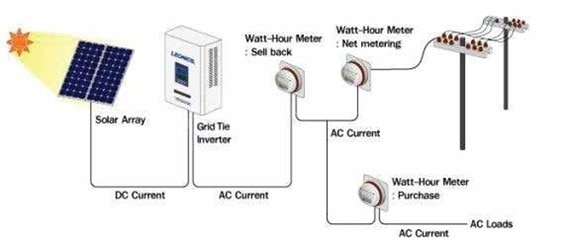
Choose on-grid solar when the utility is reliable and your priority is lowering annual bills rather than running during outages. A grid-tied inverter shuts down during a blackout because anti-islanding protection prevents electricity from reaching utility lines.
| Option | Choose it when | Main compromise |
|---|---|---|
| On-grid solar | You have dependable grid service and favourable net metering | No solar power during an outage without separate backup equipment |
| Hybrid solar | You need selected circuits operating during outages and want to use solar energy later | Battery cost, usable-capacity limits, and replacement planning |
| Off-grid solar | Grid connection is unavailable, unreliable, or more expensive than a complete standalone system | You must size panels, batteries, and backup generation for cloudy periods and peak loads |
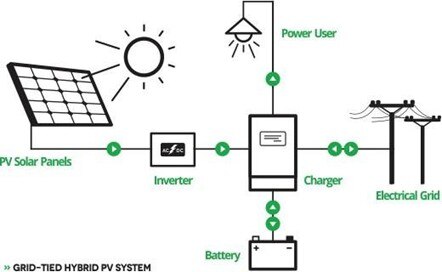
Hybrid solar suits a home that needs lights, refrigeration, internet, or a pump during outages. Compare the battery’s usable kWh and continuous kW, not its nameplate capacity; reserve settings, state-of-charge limits, inverter losses, and round-trip efficiency reduce energy delivered.
A battery is the wrong choice when outages are short, your tariff rewards daytime consumption, or battery savings cannot recover its cost and maintenance. Check fixed charges, time-of-use prices, demand charges, net metering and export limits before adding storage. Export restrictions can also make extra panels poor value.
Choose off-grid solar only when you accept energy management: large loads may need scheduling, and extended cloudy weather requires more storage or a generator. If the roof needs replacement soon, resolve that cost before committing to any design.
Compare Proposals by Delivered Energy, Not the Headline kW
A 5 kW label does not tell you how much electricity the system will deliver. Ask every installer for the modeled first-year AC kWh, the software and location used, and the assumptions behind losses, temperature, soiling, availability, and export limits. Compare those figures with your annual consumption, not with another proposal’s panel wattage.
| Item | Verify in the proposal | Why it changes the decision |
|---|---|---|
| Modeled first-year AC kWh | Annual output after inverter, wiring, temperature, and shading losses | Two arrays with identical kW can deliver different energy |
| Shading analysis | Roof-obstruction model showing hourly or seasonal shade | A chimney or nearby tree can reduce output more than the headline design suggests |
| DC-to-AC ratio | Panel DC capacity divided by inverter AC rating, plus clipping estimate | A high ratio can improve morning and winter production but clip midday peaks |
| Panel degradation warranty | Maximum annual degradation and retained-power percentage used in the lifetime model | First-year output can overstate energy available in year 20 |
| Battery and export | Usable kWh, continuous kW, backup circuits, and export assumption | Stored energy is not the same as the power available during an outage |
Also verify the utility-interconnection status, roof condition, structural review, and whether reroofing should happen before installation. For backup systems, require confirmation of transfer equipment, service size, neutral and grounding arrangements, and permitted high-power loads.
Nature Tek Solar Pvt Ltd can be asked to place these figures in one comparison sheet, including the exact panel degradation warranty rather than a generic “25-year performance” statement. Reject a proposal that supplies only panel count, total kW, and an estimated bill reduction.
Related products
 | Services Our Solar Rooftop Systems are tailored for residential, commercial, and industrial buildings. View product → |
 | Products A Hybrid Solar System combines the best of both on-grid and off-grid setups by integrating solar energy, battery backup, and grid power into one... View product → |
Frequently asked questions
How do I turn electricity bills into a usable load profile?
Record each bill’s kWh, meter-reading dates and billing days. Divide kWh by billing days to find average daily consumption, then compare all 12 months for seasonal changes.
How do I convert annual electricity usage into solar system size?
Add the last 12 months of kWh, then compare annual demand with the expected local solar yield after accounting for roof direction, shading, temperature and system losses.
What is the difference between PV capacity, inverter power and battery storage?
PV capacity is the combined panel rating in kW. Inverter power is the maximum AC output in kW. Battery storage is the energy capacity in kWh available for later use.
Which solar system type fits my reliability and backup needs?
A grid-tied system suits bill reduction without backup. A hybrid system adds batteries for selected loads during outages. An off-grid system requires enough PV, battery storage and backup generation for all demand.
Related products
 | Products An On-Grid Solar System, also known as a Grid-Tied System, is connected to the main power grid. View product → |
 | Services The Solar-Wind Hybrid System integrates both solar photovoltaic panels and wind turbines to provide a continuous and balanced renewable energy... View product → |
 | Making the switch to renewable power requires expert guidance. View product → |
 | Off-Grid Solar System (Battery-Based System) An Off-Grid Solar System works independently of the utility grid. View product → |