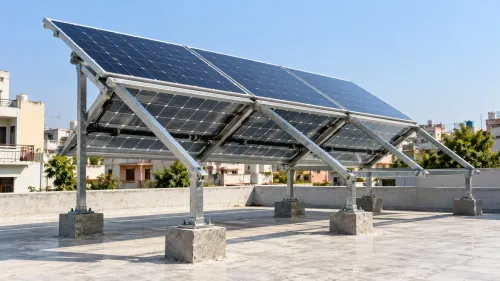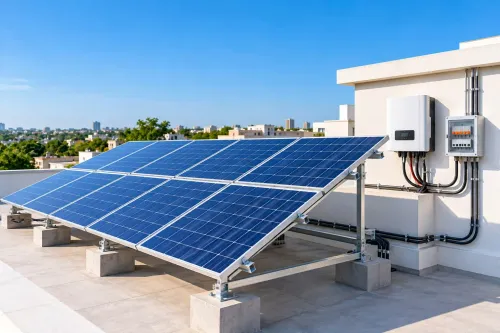
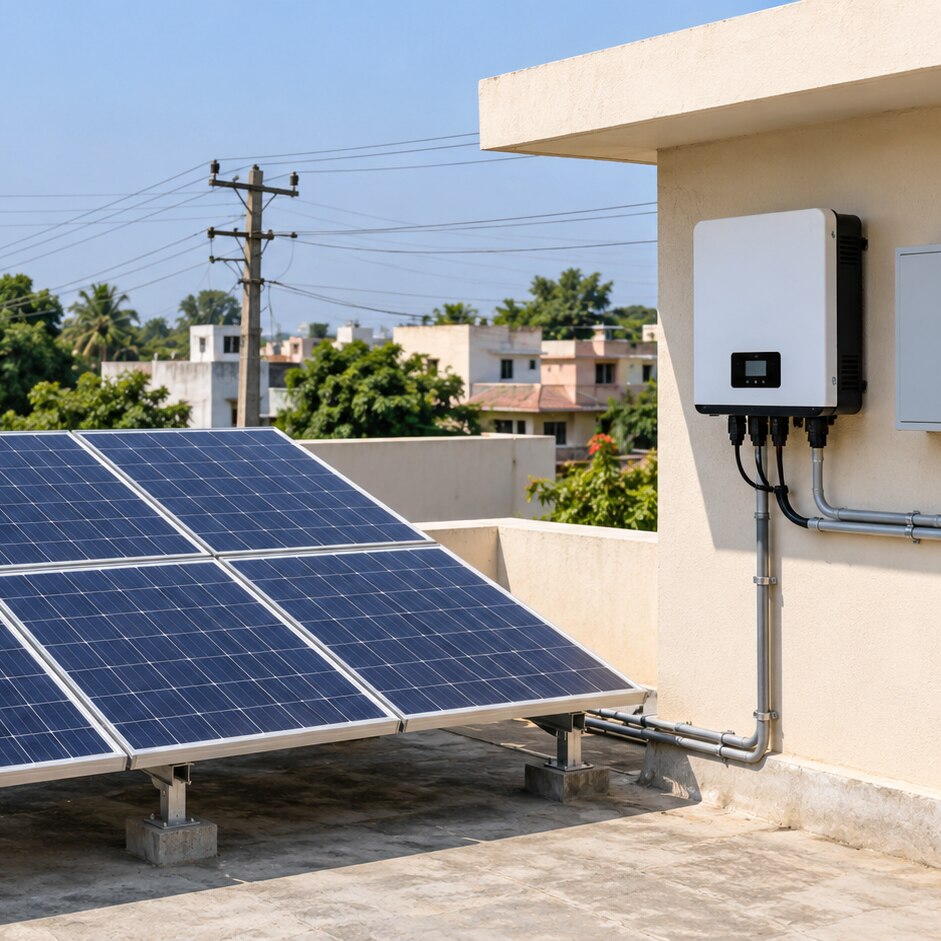
At noon, your solar array can be producing more electricity than the building uses; after sunset, the same building may draw power from the grid. The key is to follow the instantaneous power balance, then check how the meter, inverter, tariff and local approval rules turn those flows into a bill.
Key takeaways
- Solar power serves your live loads before exporting surplus electricity.
- A grid-tied inverter shuts off during an outage to protect line workers.
- Import and export meters record electricity separately for billing.
- Maharashtra approvals and system size determine how much power you can export.
What happens to power from sunrise to sunset
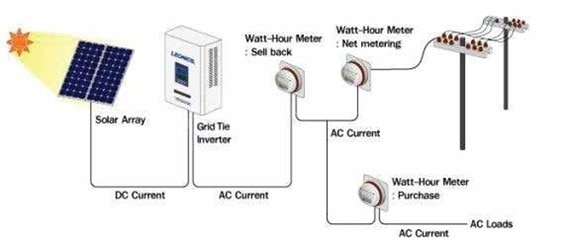
At sunrise, the panels begin producing direct-current electricity, and the inverter converts it into grid-compatible alternating current. Solar generation serves the building’s immediate demand first, so household loads such as lights and refrigerators, or business loads such as computers and pumps, use the power as it is produced.
If the building needs more electricity than the panels are producing, the grid supplies the shortfall automatically. This can happen on a cloudy morning, during a brief production dip, or whenever a large appliance starts. Solar generation and grid import can therefore occur at the same time; the grid supplies only the remaining balance.
Around midday, panel output can exceed the building’s instantaneous demand. The excess crosses the site’s grid connection and moves outward to the utility network. That is the surplus solar power flow to grid, recorded by the export meter under the applicable billing arrangement.
As afternoon production falls, the building first consumes the available solar power, then draws the deficit from the grid. After sunset, solar output stops and the grid supplies the full demand.
A conventional grid-tied inverter follows the utility’s voltage and frequency throughout this process; it does not create an independent power supply if the utility goes down.
How the inverter synchronises—and why it shuts down in an outage
A grid-tied inverter makes panel electricity usable through DC to AC conversion. It uses a maximum-power-point tracker to adjust the panels’ operating point as sunlight changes, extracting available DC energy rather than expecting a fixed output.
Before delivering power, the inverter measures grid voltage and the utility waveform. It shapes its AC output to match that waveform; this process is grid frequency synchronisation. Once connected, the inverter supplies the building’s instantaneous demand, and any surplus crosses the connection point toward the grid.
If demand is higher than solar output, the shortfall comes from the grid.
Solar production can fall when clouds pass or panels heat up. When an export limit is reached, the inverter reduces production below the panels’ available maximum, leaving some sunlight unused.
During a utility outage, a standard inverter disconnects and stops producing AC, even in bright sunlight. Its anti-islanding protection prevents it from energising lines that workers may assume are dead. Because it follows the utility’s waveform instead of creating one, it cannot safely run the building by itself.
A battery alone does not remove this restriction. Backup operation needs:
- an inverter that forms a local AC grid;
- equipment that isolates the building from the utility;
- controls that balance backup loads and solar supply.
This equipment usually serves a defined backup-load panel, not every circuit automatically.
How meters and tariffs record imports and exports
The meter records energy crossing the grid connection, not every unit the panels produce. A bidirectional net meter adds electricity taken from the grid to the import register and electricity sent to the grid to the export register, both measured in kilowatt-hours (kWh). Solar used immediately inside the premises never enters either register.
| Arrangement | How the bill is calculated | What to check |
|---|---|---|
| Net metering | Billing-period netting subtracts exported kWh from imported kWh, then applies the tariff to the balance | Credit rollover, expiry, fixed charges and demand charges |
| Gross metering | All solar generation is measured and paid separately; all building consumption is billed as grid import | Generation payment rate and the retail import tariff |
| Feed-in arrangement | Exported kWh earn a stated payment or credit, while imported kWh are charged under the applicable retail tariff | Export rate, contract term and settlement schedule |
Net metering does not mean your exported electrons return to you at night. It is an accounting method: electricity used on site usually avoids a retail purchase, while exported electricity may receive a lower credit than the retail rate. A bill can still include connection, service, taxes or demand-related charges after the energy calculation.
If an export limit applies, a power meter or current transformer measures flow at the grid connection. The inverter reduces output as the limit is reached, so surplus available from the panels is curtailed rather than recorded as export.
A worked example: midday export, evening import and the monthly bill
A 5-kilowatt system produces 24 kWh on a sunny day. The building uses 10 kWh during daylight, so that amount is self-consumption: it avoids buying 10 kWh at the retail tariff. The remaining 14 kWh is net export through the bidirectional meter.
The building then uses 18 kWh after sunset, when the panels produce nothing. That energy becomes grid import. The meter records both directions; the building does not physically receive the same exported electrons later.
For a 30-day month, the figures are:
- Solar generation: 24 × 30 = 720 kWh
- Daytime self-consumption: 10 × 30 = 300 kWh
- Exported energy: 14 × 30 = 420 kWh
- Imported energy: 18 × 30 = 540 kWh
In this monthly solar bill example, assume the retail import tariff is ₹8 per kWh, exported energy earns a ₹3 per kWh credit, and the fixed monthly charge is ₹200. The calculation is:
540 × ₹8 − 420 × ₹3 + ₹200 = ₹3,260
Solar production was 720 kWh, but the bill is not based only on that total. Self-consumed units avoid the retail rate, exported units receive the stated credit, and fixed or demand charges remain. Change the export rate, billing arrangement or tariff, and the result changes.
How system size and Maharashtra approvals limit exports
A 10 kW panel array does not mean you can export 10 kW. The practical ceiling is the lower of the inverter AC capacity, the approved export limit, and the power available after serving the building’s instantaneous load.
A 10 kW array paired with an 8 kW inverter can export no more than about 8 kW AC; at peak sunlight, the inverter may clip the extra DC output.
Your building demand determines how much reaches the grid at each moment. If the panels produce 6 kW while the building uses 4 kW, only 2 kW is available for export. If demand rises to 8 kW, the same system imports 2 kW instead.
Annual electricity consumption helps size the array for useful yearly generation, but it does not authorise a larger momentary export.
In Maharashtra, the relevant DISCOM—such as MSEDCL—approves the proposed capacity and connection conditions. Check these figures before ordering equipment:
- Sanctioned load or contract demand on your electricity bill
- PV panel capacity in kW and inverter AC capacity
- Approved net-metering or export capacity
- Export limit programmed at the point of common coupling
- Annual electricity consumption used to justify system sizing
A zero-export design uses a meter or current transformer at the grid connection. When local demand falls, the controller reduces inverter output instead of permitting export. Nature Tek Solar Pvt Ltd can use this load, consumption and approval data to avoid specifying panels that the inverter or Maharashtra DISCOM cannot legally use.
Related products
 | Products An On-Grid Solar System, also known as a Grid-Tied System, is connected to the main power grid. View product → |
 | Products A Zero Export Metering System is a smart solar control solution designed to ensure that no excess solar power is exported to the electricity grid. View product → |
Frequently asked questions
What happens to solar power from sunrise to sunset?
Panels produce direct current, the inverter converts it to alternating current, and the building uses that power first. Surplus generation flows to the grid.
Why does an on-grid inverter shut down during a power outage?
It stops producing electricity when the grid fails to prevent backfeeding and protect utility workers repairing power lines.
How are solar imports and exports recorded?
A bidirectional meter records electricity drawn from the grid as imports and surplus solar sent to the grid as exports. The tariff and approved billing arrangement determine the monthly credit or charge.
How do system size and Maharashtra approvals limit exports?
Your approved solar capacity, sanctioned load, utility rules and metering arrangement set the practical limit for installation and exports. Confirm these requirements with the local distribution utility before commissioning.